Secure online checkout

Select a Free Delivery Date*

ISO 9001 Quality Management

Award-winning customer service

Slugs – dealing with our least welcome garden visitor

Of all the creatures great and small that share your piece of outdoor heaven, slugs probably have the biggest image problem. 

However, in the diverse ecosystem of a garden, slugs play an important role, not just as pests, but as vital participants in nutrient cycling and decomposition. They help break down dead organic matter, enriching the soil and supporting plant health. 

Recognising this, gardeners can adopt a more balanced approach to managing slugs, focusing on methods that respect and maintain this ecological role. 


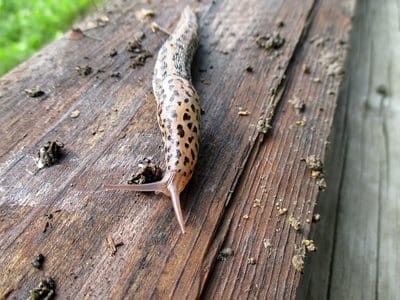
Blog - leopard slug

Instead of using harmful chemicals to deal with garden pests, you can employ physical barriers and selective planting to effectively manage slug populations. This approach not only protects the garden but also supports broader biodiversity, turning a challenge into an opportunity for more sustainable gardening.

Don’t forget, slugs are also a valuable food source for more welcome garden visitors such as hedgehogs, useful garden beetles and the song thrush so do what you can to encourage natural predators. 

Slug pellets are powerful poisons that, like all chemical methods of pest control, can pose a danger to pets, birds and other wildlife, even children. They do not discriminate between helpful slugs and those that feast on your plants and can even make the problem worse by stimulating slug reproduction.

Slugs are surprisingly hardy creatures, so your best strategy is to work with them rather than against them, using some of the following more natural methods of control outlined below.

Capture and move slugs

You can set up slug and snail traps then release them away from garden areas, or rehome them in your compost heap. Simply leaving them to perish in the trap can attract more slugs and snails so you will have to decide in advance how you want to deal with your captives. If you have the time and patience, physically picking them off your plants and moving them elsewhere is a sure-fire method of protecting your plants.


Natural slug repellants

Slugs make their way around your garden in a unique way. They use their slime to enable them to traverse difficult terrain, including abrasive and sharp materials that in theory should be hazardous for something as soft bodied and seemingly vulnerable as a slug.

If you can somehow deal with the slime, then you are literally stopping the slug in its tracks. Absorbent materials help. Some people swear by a liberal portion of porridge oats around the areas you want to protect although these are likely to get eaten by other garden visitors and will not serve the purpose once it rains. There are materials you can purchase and most garden centres will sell different kinds of slug barrier which make moving difficult or uncomfortable for them and discourage the slugs from entering protected areas of your garden.

Believe it or not, you can also use slug fences (think tiny, tiny deer fencing) to protect vulnerable plants. Keeping your soil dry or at least avoiding irrigating the ground in the evening/nightfall when slugs are most active will also make it less attractive to them.

Companion planting

Some plants and varieties of produce are wildly attractive to slugs, others are mostly ignored. However, some are loathed by them. You can make your garden or veg patch less of a slug magnet with selective planting. For instance, strongly scented plants like herbs, lavender and marigolds planted alongside plants that are attractive to slugs will help to deter them. 

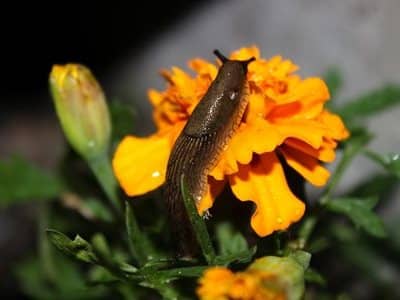
Blog - slug

Chemical-free slug eradication

Both slugs and snails harbour lungworm larvae which can be picked up from contact with the creatures themselves (mostly by eating them) or from the slime trail they use to get around your garden. While there are forms of lungworm that can infect and harm humans in other parts of the world, here in the UK it is our pet dogs and cats at risk from infestation and lungworm can prove fatal if untreated. So, it is understandable that in some circumstances, there is a need to eradicate them.

As mentioned above, chemicals not only kill slugs but have a detrimental effect on the wider environment so we do not advise this method. If all else fails, then salt can be used to kill slugs without endangering anything else – apart from a few plants if you are too liberal with the salt application. This method isn’t for the faint-hearted and only works with bold-as-brass, above-ground slugs who leave helpful slime trails so you can track them down. 

Another solution is to introduce nematodes into your garden, microscopic worms which are a natural enemy of slugs. They kill them so you don’t have to and have the advantage that they won’t harm children, pets or wildlife.

You can give your plants a fighting chance by transplanting them when they are bigger and stronger. Some people will even grow a ‘sacrificial bed’ of slug delicacies to contain the pest within particular areas of the garden, hopefully somewhere well away from the part the gardener is trying to protect!

If you’d like to keep up to date with Rolawn advice, news and special offers by email, please sign up to our newsletter or follow us on FacebookInstagram or X.

Guest Author: Melanie Hannam
With an Honours Degree in Psychology from Durham University, and a qualification in journalism through the NCTJ, Mel draws on her knowledge of and experience in Journalism and Communications as well as her love of literature, travel and adventure to write on a range of subjects. Mel is an award-winning writer who specializes in health sector communications, but her primary passion is sled dogs and she often writes for canine-related publications and blogs.


Important update: Temporary 6.5% surcharge effective 7 April 

At Rolawn, we are committed to maintaining the high standards of quality and service our customers expect, so we want to be open with our customers about a change that will affect pricing from Tuesday 7th April. 

This decision has been taken in response to disruption to energy supplies, which has led to significant increases in wholesale prices, affecting not only fuel and fertiliser but also costs throughout our wider supply chain. As a business that relies heavily on fuel for both transport and operations, these sustained cost pressures have become increasingly difficult to absorb.  

While we have worked hard to mitigate the impact, the scale and pace of recent price increases have now exceeded what we can sustain internally, and we therefore need to recover a proportion of these externally driven increases. 

From Tuesday 7th April, a temporary 6.5% surcharge will apply to all products.  

We know that any increase in price is frustrating, particularly at a time when many businesses and households are already feeling under pressure. That is why we want to be clear that this is not a decision we have made lightly, and not one we wanted to make. It has been introduced solely to help offset unavoidable cost inflation and allow us to continue delivering the quality, reliability and service standards associated with Rolawn. 

We will continue to monitor market conditions closely and will review this surcharge as soon as circumstances allow, providing reasonable notice of any changes. We recognise that any price increase is unwelcome, but this step is necessary to ensure the continuity and reliability of our operations during a period of ongoing uncertainty. 

We remain committed to providing the quality, reliability and service standards you expect from Rolawn, and we truly appreciate your understanding and continued support. 

If you have any questions, please contact our customer support team who will be happy to help.