Secure online checkout

Select a Free Delivery Date*

ISO 9001 Quality Management

Award-winning customer service

Leaf blight

How to identify leaf blight

  1. Has it been cool and wet?
  2. When you look at your turf is it slightly yellow and brown?
  3. If you examine some leaves closely, do you see yellow, brown or red spots on them?
  4. Is your turf starting to look thin?

If you answer yes to these questions, you may have leaf blight disease in your turf and you may have to control it.

General information

Leaf blight disease is caused by fungi that attack and kill the leaves of turf. In general, leaf blight does not kill the entire turfgrass plant, and once the disease stops developing, the turf will recover.

Info centre - lawn diseases -leaf blight

However, when cool wet weather persists for weeks at a time and your turf is under fertilised, the fungi can become so severe that it can kill your turf. There are many different fungi that can cause leaf blight, but most of them behave similarly and can be managed using the same techniques. Most leaf blight fungi produce abundant spores (microscopic seed-like cells) that can spread the fungus in your turf.

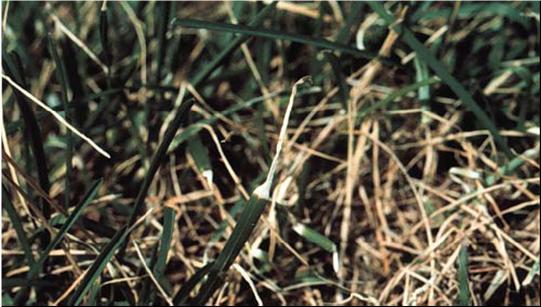
When you mow the lawn, aerate, walk on, or roll your turf, you can move the spores. The spores are too small for you to see and they are not produced on dry leaves like rust disease, so you will not see them on your shoes. When they attack your leaves, they will produce very small yellow spots that turn tan coloured or black and sometimes have a red border. You can see the spots with your naked eye. When the weather is dry and sunny, leaf spots are generally not a problem. The taller your grass, the more disease you will have.

How can you control leaf blight?

The methods used to control the disease are quite simple:

  1. Keep your lawn fertilised properly. Too little or too much fertiliser will increase the severity of leaf diseases.
  2. Mow your turf properly. As the turf grows tall, it stays wet longer during the day, and this allows leaf blight to develop.
  3. Water your turf properly. If you irrigate your turf, do it during the morning or early afternoon. This will give the turf enough time to dry off before the night.

Are some grasses more susceptible to leaf blight than others?

Yes, grasses differ in resistance to this disease. If you are buying turf, ask your producer if they use resistant types of grass. Using resistant grasses will reduce leaf blight severity, but it cannot eliminate the disease.

Are there fungicides that will control leaf blight?

Yes, there are fungicides approved for use to control leaf blight. Fungicides should only be used after the other suggested methods for controlling this disease have failed to produce satisfactory results. Before you use a fungicide, it is recommended that you have a turf expert identify the disease you have observed. The Sports Turf Research Institute is the leading agronomy organisation in the UK, you can visit their website at www.stri.co.uk. Fungicides are toxic, and should be used only when needed and handled carefully. We also recommend that you obtain advice about chemical and non-chemical products direct from the manufacturers.

Remember

Leaf blight can attack all types of turf, but if your turf is managed well this disease should not be destructive.

Important update: Temporary 6.5% surcharge effective 7 April 

At Rolawn, we are committed to maintaining the high standards of quality and service our customers expect, so we want to be open with our customers about a change that will affect pricing from Tuesday 7th April. 

This decision has been taken in response to disruption to energy supplies, which has led to significant increases in wholesale prices, affecting not only fuel and fertiliser but also costs throughout our wider supply chain. As a business that relies heavily on fuel for both transport and operations, these sustained cost pressures have become increasingly difficult to absorb.  

While we have worked hard to mitigate the impact, the scale and pace of recent price increases have now exceeded what we can sustain internally, and we therefore need to recover a proportion of these externally driven increases. 

From Tuesday 7th April, a temporary 6.5% surcharge will apply to all products.  

We know that any increase in price is frustrating, particularly at a time when many businesses and households are already feeling under pressure. That is why we want to be clear that this is not a decision we have made lightly, and not one we wanted to make. It has been introduced solely to help offset unavoidable cost inflation and allow us to continue delivering the quality, reliability and service standards associated with Rolawn. 

We will continue to monitor market conditions closely and will review this surcharge as soon as circumstances allow, providing reasonable notice of any changes. We recognise that any price increase is unwelcome, but this step is necessary to ensure the continuity and reliability of our operations during a period of ongoing uncertainty. 

We remain committed to providing the quality, reliability and service standards you expect from Rolawn, and we truly appreciate your understanding and continued support. 

If you have any questions, please contact our customer support team who will be happy to help.