Secure online checkout

Select a Free Delivery Date*

ISO 9001 Quality Management

Award-winning customer service

How to build a raised bed

To get started, you need to do a bit of planning:

Decide how big your raised bed is going to be.

When planning your raised beds it’s important to remember you’ll need to be able to access and work on it without having to stand on the bed, as this will flatten the soil. You’ll also need to make a path around the bed so you can get to it easily.

The minimum width for walking is usually about 30cm and if you want to use a wheelbarrow then you will need to allow sufficient additional access. If you make the paths too narrow, the bed will be too difficult to work on. If you or anyone who will be working in your garden uses a wheelchair or other mobility aid then you’ll have to take this into account too.

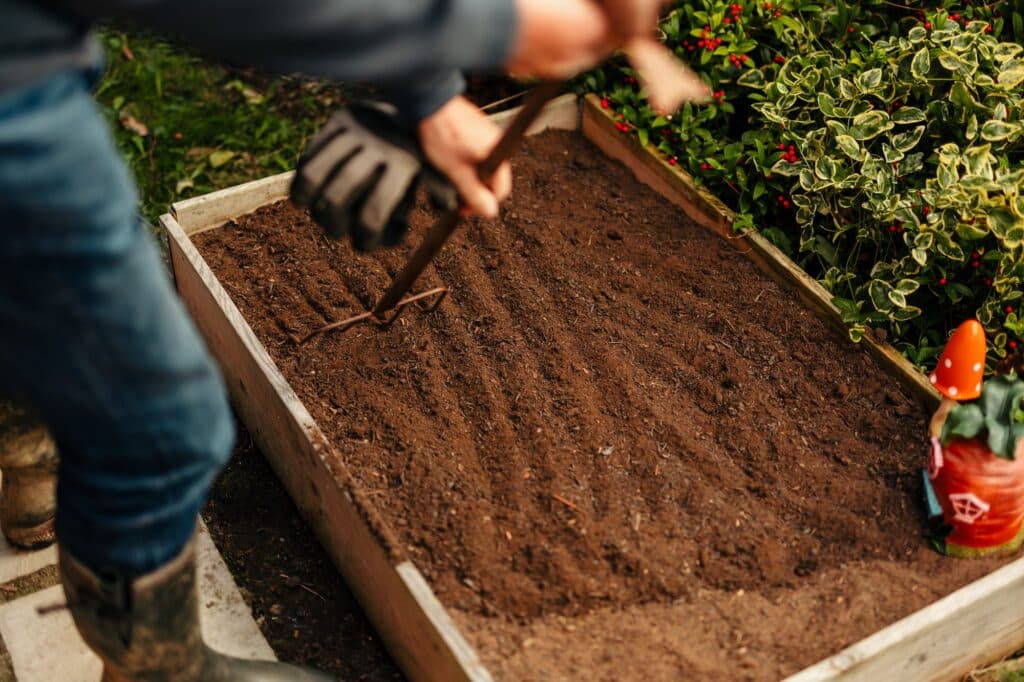
Product Images- Raised bed planter with rake 2

Decide what your bed is going to be made from.

Raised beds can be made from various materials. You need to decide what your budget for your new project is and whether you want this to be a permanent feature of your garden. There are three main options when sourcing your materials:

  1. Recycle materials such as timber planks
  2. Purchase timber or masonry from local builders merchant or DIY store
  3. Buy readymade kits from suppliers such as:


The cheapest option is timber although bear in mind that even treated it will not be as long lasting as some options. Railway sleepers look great and last a long time but can be expensive and quite difficult to lift and cut to size. Use sleepers which are untreated or treated with non-toxic preservatives. An alternative is second-hand scaffolding planks. Masonry is attractive and permanent but can be an expensive option and it’s worth seeing what you can find at reclamation yards or recycle from other areas of your garden.

Building your raised bed.

There are a few steps involved. Building a raised bed is not a five minute job but once the initial construction is complete, your bed should be easy to maintain and worth the effort for many growing seasons to come. Our quick guide assumes you are using timber to construct your raised bed but you can adapt this if you are using masonry or follow the manufacturer’s instructions if you have purchased plastic panels.

  1. You’ve already decided on the site and dimensions of your new raised bed. You need to clear away any existing vegetation and level the ground where the bed will stand if necessary.
  2. Using string and stakes, mark out the area of your new bed. You can use a spirit level to check that you are not on a slope and everything is straight.
  3. Make a cutting list for your boards and cut your timber panels to size.
  4. Stout internal corner posts (2 x 2 inch timber) should be used. It’s a good idea to treat these as they will be in contact with the ground and will be prone to rot over time. Sink them 12 to 18 inches into the ground to support the panels. For extra stability for a larger bed, sink additional stakes every 5ft to support the sides.
  5. Using non-rusting screws, attach your panels to the corner posts.
  6. For a useful finishing touch you can fit a decorative finial on top of each corner post. Not only does this add to the general appearance of your raised bed but it will prevent your hosepipe being pulled across the plants when you water.

Filling your raised bed with soil.

  1. Now it’s time to work on your soil. Cultivate and enrich the underlying soil with well-rotted compost or other organic matter. Dig well to ensure any perennial roots are removed and the soil is loosened.
  2. Fill up the bed with layers of good quality topsoil alternated with layers of organic matter such as well rotted compost or manure. Our ‘Selecting the right topsoil’ video gives advice on ensuring you use the right topsoil for your project. Firm each layer down as you work. The soil you use will depend on what you plan to grow in the raised bed. Remember, in a raised bed you can grow plants that don’t usually thrive in your garden because of the underlying soil type that you are working with. Choosing the right topsoil for your project is vital and Rolawn has different grades of topsoil suitable for either specialist or more general planting applications.
  3. Wait a few weeks before planting up the beds to allow the soil to settle.
  4. Raised beds can also be built on top of hard surfaces but will need to be deeper, ideally at least 2ft so plants can root properly.
  5. Your new raised bed is now ready to enjoy.

Find out about the benefits of raised beds here, or if you’re considering the no-dig approach check out our guide to creating a no-dig bed.

Ready to buy topsoil? Our task-specific topsoils are designed for horticultural success. Click here for product information. 

Important update: Temporary 6.5% surcharge effective 7 April 

At Rolawn, we are committed to maintaining the high standards of quality and service our customers expect, so we want to be open with our customers about a change that will affect pricing from Tuesday 7th April. 

This decision has been taken in response to disruption to energy supplies, which has led to significant increases in wholesale prices, affecting not only fuel and fertiliser but also costs throughout our wider supply chain. As a business that relies heavily on fuel for both transport and operations, these sustained cost pressures have become increasingly difficult to absorb.  

While we have worked hard to mitigate the impact, the scale and pace of recent price increases have now exceeded what we can sustain internally, and we therefore need to recover a proportion of these externally driven increases. 

From Tuesday 7th April, a temporary 6.5% surcharge will apply to all products.  

We know that any increase in price is frustrating, particularly at a time when many businesses and households are already feeling under pressure. That is why we want to be clear that this is not a decision we have made lightly, and not one we wanted to make. It has been introduced solely to help offset unavoidable cost inflation and allow us to continue delivering the quality, reliability and service standards associated with Rolawn. 

We will continue to monitor market conditions closely and will review this surcharge as soon as circumstances allow, providing reasonable notice of any changes. We recognise that any price increase is unwelcome, but this step is necessary to ensure the continuity and reliability of our operations during a period of ongoing uncertainty. 

We remain committed to providing the quality, reliability and service standards you expect from Rolawn, and we truly appreciate your understanding and continued support. 

If you have any questions, please contact our customer support team who will be happy to help.