Secure online checkout

Select a Free Delivery Date*

ISO 9001 Quality Management

Award-winning customer service

Broadleaf weeds in your turf

Broadleaf weeds are so called, because they produce leaves that generally are oval or elongated, and are wider than a grass leaf. In fact, broadleaf weeds have many biological differences compared to turfgrass, and this allows them to be controlled very effectively in turf. The point should be made that the concept of ‘weed’ is man-made, and simply means an unwanted plant.
 
The broadleaf plants that can grow in your lawn are not harmful to you or your turf. There are many broadleaf weeds that can appear in your turf, but the four listed below are the most common.

Common weeds found in turf

  1. Dandelion (Taraxacum officinale)
  2. Buttercup (Ranunculus repens/acris)
  3. Clover (Trifolium repens)
  4. Daisy (Bellis perennis)

Identification

  1. Are there green plants in your turf with wide (10mm) leaves?
  2. Is your lawn older than one year or newly seeded?
  3. Is your turf thin (sparse), can you see bare soil patches in your lawn?
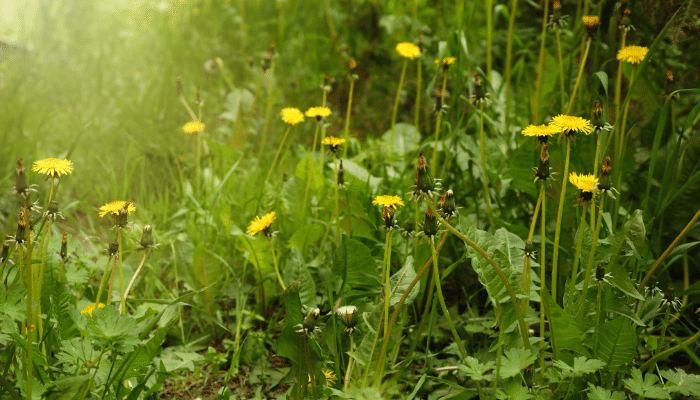
Dandelion leaves and flowers in the garden

If you answer yes to the above questions, your lawn has broadleaf weeds growing in it. Read on to learn how to determine which weed(s) you might have and how to rid your lawn of them.

Why do weeds appear in turf?

Weeds establish themselves in your turf because the turf is thin (sparse) and open (soil is visible). The seeds of weeds are everywhere turf is grown, but a thick, healthy turf will prevent most weeds from growing. Weeds do not ‘like’ to compete with a strong, thick turf. If you have weeds in your turf when it is delivered, you have purchased poor quality turf. However, before you call your landscaper or turf producer, check to see if the weeds are growing up through the joints or on the edges of your turf. If the weeds are there, your turf installation was not as good as it should have been. Weed seeds will be in the ground that you laid your turf on. Most seeds can not easily germinate and grow through quality turf, but once in a while they do. To minimise weed seeds from growing up through your new turf, prepare your soil properly.

If weeds appear in turf that was laid more than a year ago, it is because the turf has become thin (sparse) or damaged. When a weed seed can fall to the soil and has room to grow, it will. The best way to prevent weeds from getting established is to maintain a thick and healthy turf. Fertiliser and the lawnmower are your best tools for this job.

How to remove weeds from a lawn

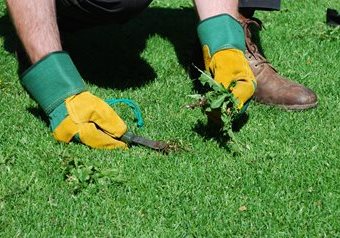
Once weeds are in your turf, you need to remove them. There are two ways to remove them: dig them out; or kill them with a herbicide. There is nothing wrong with digging them out, and it is good exercise and environmentally safe. Most of the common weeds that appear in lawns will dig out easily if the soil is moist, but a few will not and these need to be sprayed. When digging a weed out, it is best to use a sharp knife or weed digging tool (both can be found in a garden centre). Slide the knife down under the weed and cut off the root. Then, pull the weed out and discard it away from your turf. If you leave the weeds on or near your turf, they could discharge their seeds, and your problem will grow again.

Dandelions, buttercup, and daisies can be easily dug out of your turf, but clover is difficult to remove with a knife. To remove clover, a herbicide is generally used. You should dig up a small sample of the weed you want to remove from your turf and take it to your garden centre expert. They will tell you what it is and what to use to control it. When weeds are treated with a herbicide (weedkiller), it will take them more than a week to die. After they are dead, you can rake up the dead plants and discard them.

What to do after you remove the weeds

After the weeds are removed, care for your turf properly. If your turf was mostly weeds or if there are bare spots in your turf, you may need to purchase a new turf or overseed.

How to prevent weeds from establishing in your turf

The best method is to grow thick, healthy turf, but you can also use selective herbicides to control some weeds. Weed controlling herbicides are applied like fertiliser, and this is usually done in the spring. Check with your garden centre expert for advice on these products.

Info centre - dealing with broadleaf weeds in lawns

Overseeding as part of your annual lawn maintenance regime will give your lawn a denser sward and help prevent weeds encroaching. 

Remember

Always start with quality turf. If the soil under your turf is exposed, weeds will grow there. Good gardening and turf care are the best methods to prevent weeds from invading your turf.

Further guidance

Further lawn care advice can be found in our Information Centre. You can also sign up for lawn tips to receive regular lawn care advice, news and promotional offers by email which will help you get the best from your lawn.

For more techniques to help you maintain a healthy lawn, explore our other lawn aftercare advice.

Recommended products:

No products were found matching your selection.

Lawn care reminders to your inbox

You can also sign up to our newsletter to receive free seasonal lawn care advice and reminders of essential maintenance, as well as general horticultural advice and special offers from Rolawn.

Important update: Temporary 6.5% surcharge effective 7 April 

At Rolawn, we are committed to maintaining the high standards of quality and service our customers expect, so we want to be open with our customers about a change that will affect pricing from Tuesday 7th April. 

This decision has been taken in response to disruption to energy supplies, which has led to significant increases in wholesale prices, affecting not only fuel and fertiliser but also costs throughout our wider supply chain. As a business that relies heavily on fuel for both transport and operations, these sustained cost pressures have become increasingly difficult to absorb.  

While we have worked hard to mitigate the impact, the scale and pace of recent price increases have now exceeded what we can sustain internally, and we therefore need to recover a proportion of these externally driven increases. 

From Tuesday 7th April, a temporary 6.5% surcharge will apply to all products.  

We know that any increase in price is frustrating, particularly at a time when many businesses and households are already feeling under pressure. That is why we want to be clear that this is not a decision we have made lightly, and not one we wanted to make. It has been introduced solely to help offset unavoidable cost inflation and allow us to continue delivering the quality, reliability and service standards associated with Rolawn. 

We will continue to monitor market conditions closely and will review this surcharge as soon as circumstances allow, providing reasonable notice of any changes. We recognise that any price increase is unwelcome, but this step is necessary to ensure the continuity and reliability of our operations during a period of ongoing uncertainty. 

We remain committed to providing the quality, reliability and service standards you expect from Rolawn, and we truly appreciate your understanding and continued support. 

If you have any questions, please contact our customer support team who will be happy to help.