Secure online checkout

Select a Free Delivery Date*

ISO 9001 Quality Management

Award-winning customer service

Fertilising your turf

All plants need nutrients or fertilisers. Plants generally obtain the nutrients they need by absorbing them through their roots. That is why turf with a well developed, healthy root system will always produce a better lawn.
 
Keep reading for advice on how and when to fertilise your lawn to keep it healthy, green and hard wearing.

Why fertilise your lawn?

To encourage good rooting, you need to ensure that the plant has proper nutrients. Proper plant nutrition means that the soil has all of the 16 essential elements available to the grass, and the amounts of these elements are not too high or too low. If the level of nutrients is too high, they will be toxic to the grass and could injure or kill it. Too little will generally not kill the grass, but it will weaken it, making it thin and discoloured.

Does your new Rolawn turf come fertilised?

Yes, your turf does come already fertilised. Rolawn prepares your new turf to look beautiful on the top and to grow strong, deep roots. We do this by using a formulation of fertiliser that will cause the turf leaves to be dense and green, while keeping the roots lean and hungry for nutrients.

When your new turf is installed, it quickly seeks out additional nutrients. That’s why it’s recommended to apply a pre-turfing fertiliser into the soil before laying – giving your lawn the best start possible. Avoid reapplying fertiliser immediately after installation, as this can overwhelm young roots.

Info Centre - feeding spreader

When do you need to fertilise your lawn?

Deciding when to fertilise is not as easy as it sounds. The best method used to decide this is measuring the amount of nutrients that are in both the soil and the grass plant. However, this is costly and takes time, and must be done by a trained professional. We recommend that the homeowner uses a combination of visual inspection and general guidelines from Rolawn. There are three main features to fertilizing:

When to apply?
How much to apply?
What to use?

When your lawn starts to grow in the spring, put on the first application of the new season. Under certain climatic and growth conditions a newly-laid lawn that has not been laid on soil which includes a pre-turfing fertiliser, might need to be fed within the first few months. Ideally a lawn fertiliser should be applied just before rainfall is forecast, when the soil is moist but the sward is dry.

A suitable spring lawn food should ideally be applied in early spring (March/April). A second application can be applied 6 to 8 weeks later.

An autumn lawn food should ideally be applied in early autumn (September).

How do you calculate the amount of fertiliser to apply?

Fertilisers are usually designated by three numbers printed on their packaging. The three numbers refer to the percentage of the product in the container that is nitrogen (N), phosphorus (P), and potassium (K). The numbers are always in the same order: N:P:K. For example, if a 14 kilogram bag of fertiliser lists the N:P:K as 10:7:3, these numbers are the respective percentages of nitrogen, phosphorus and potassium.

You should use a fertiliser with all three elements, but check with your local garden centre for some help with both the selection and calculations for applying fertiliser. If you are not satisfied with the results after fertilising your lawn, consult a turfgrass expert. There are many reasons why grass does not grow properly, and lack of sufficient nutrients is only one possible cause. You may be wondering why fertilisers are mostly N, P and K, when there are 13 other elements needed for good turf growth. Two of these elements are carbon and oxygen, and these are taken from the air. Generally, the other 11 elements exist in sufficient quantities in most soils. In addition they are not needed in as great a quantity as N, P and K.

For balanced lawn establishment, use a slow-release fertiliser like GroRight® Lawn Establishment Fertiliser 2kg, formulated specifically for turf and seeding preparation.

What is the best way to spread your fertiliser?

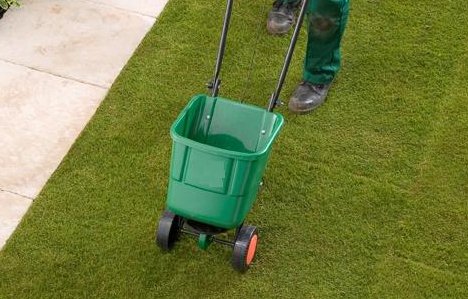
It is important that the fertiliser be spread uniformly, otherwise your turf will be both dark green and yellow. You can spread fertiliser in many ways – by hand, with a rotary spreader, or with a drop spreader. Using your hand is appropriate for small areas where it is difficult to turn a spreader. The drop spreader is very accurate but you can easily misapply fertiliser using it because the fertiliser is difficult to see in the turf.

A method to overcome this difficulty is to mix a small amount of lime in with the fertiliser to make it white. The rotary spreader (hand-held or push) will cover a large area quickly, and generally, your application will be uniform. Try some different methods and talk to your neighbours or a garden centre manager to make a good choice.

Visit our guide to using a spreader to fertilise your lawn for further advice on types of spreaders and how to calibrate them.

Further guidance

Further lawn care advice can be found in our Information Centre. You can also sign up for lawn tips to receive regular lawn care advice, news and promotional offers by email which will help you get the best from your lawn.

For more techniques to help you maintain a healthy lawn, explore our other lawn aftercare advice.

Recommended products:

No products were found matching your selection.

Lawn care reminders to your inbox

You can also sign up to our newsletter to receive free seasonal lawn care advice and reminders of essential maintenance, as well as general horticultural advice and special offers from Rolawn.

Important update: Temporary 6.5% surcharge effective 7 April 

At Rolawn, we are committed to maintaining the high standards of quality and service our customers expect, so we want to be open with our customers about a change that will affect pricing from Tuesday 7th April. 

This decision has been taken in response to disruption to energy supplies, which has led to significant increases in wholesale prices, affecting not only fuel and fertiliser but also costs throughout our wider supply chain. As a business that relies heavily on fuel for both transport and operations, these sustained cost pressures have become increasingly difficult to absorb.  

While we have worked hard to mitigate the impact, the scale and pace of recent price increases have now exceeded what we can sustain internally, and we therefore need to recover a proportion of these externally driven increases. 

From Tuesday 7th April, a temporary 6.5% surcharge will apply to all products.  

We know that any increase in price is frustrating, particularly at a time when many businesses and households are already feeling under pressure. That is why we want to be clear that this is not a decision we have made lightly, and not one we wanted to make. It has been introduced solely to help offset unavoidable cost inflation and allow us to continue delivering the quality, reliability and service standards associated with Rolawn. 

We will continue to monitor market conditions closely and will review this surcharge as soon as circumstances allow, providing reasonable notice of any changes. We recognise that any price increase is unwelcome, but this step is necessary to ensure the continuity and reliability of our operations during a period of ongoing uncertainty. 

We remain committed to providing the quality, reliability and service standards you expect from Rolawn, and we truly appreciate your understanding and continued support. 

If you have any questions, please contact our customer support team who will be happy to help.